
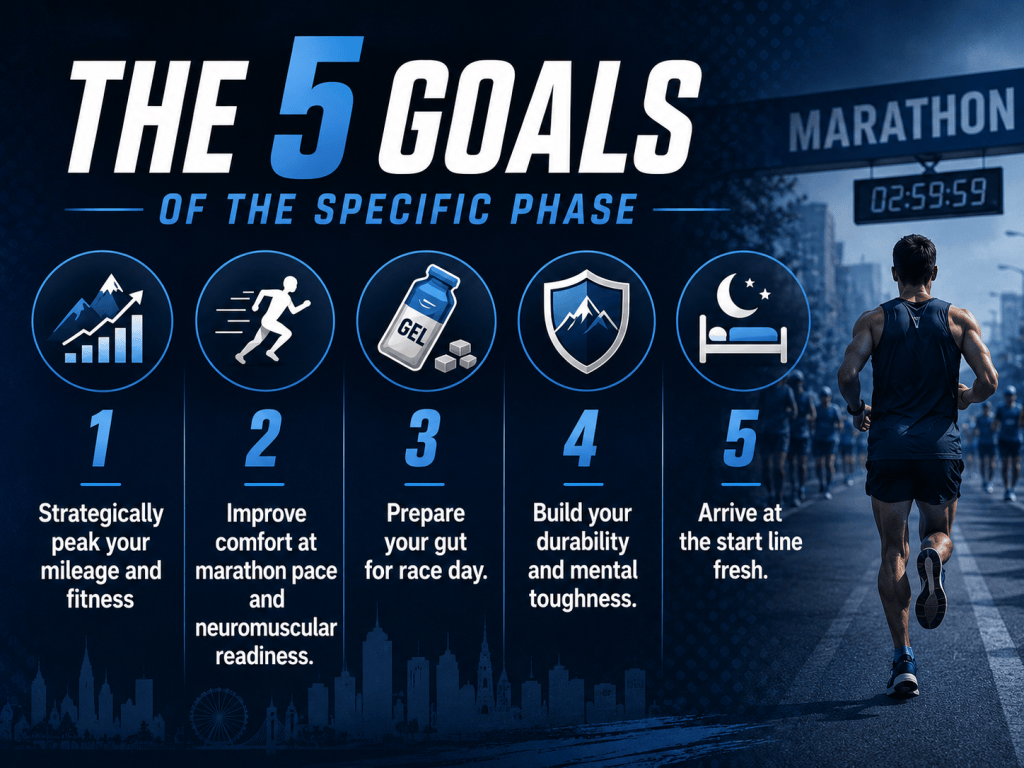
A good marathon block includes:
- A Base Phase where you build up aerobic endurance
- A Support Phase where you work on increasing VO2 Max and Lactate Threshold, and
- A Specific Phase that culminates in a taper.
Let’s unpack the 5 key goals of the Specific Phase, why they’re important, and how to achieve them.
1. Strategically peak your mileage and fitness.
The first goal is simple – in the specific phase, your weekly mileage should reach its peak for the block and, with it, so should your fitness.
HOW to peak your mileage: Continue the steadily increasing weekly mileage trend you started in the Base phase and continued in Support phase until about 3 weeks before the race. It’s amazing how many people get this wrong, either forcing a big jump in mileage too quickly or leaving the taper too late and trying to ‘cram for the test’. You won’t add any fitness in the last 2-3 weeks that will be meaningful on race day – you want to peak your mileage and long run 3 to 5 weeks before the race.
2. Improve comfort at marathon pace and neuromuscular readiness.
Prior to the Specific Phase, the goal of most workouts is, essentially, to make marathon pace (MP) faster. In the Specific Phase, the goal is to get comfortable holding that pace for longer and to build neuromuscular readiness so our bodies know exactly what MP feels like.
HOW to improve comfort at marathon pace: Shift the focus of your workouts to locking in marathon pace. Example workouts include: Marathon-pace runs (eg warm-up, then 8-16km at marathon pace, then cool down), quality long runs with chunks at or around marathon pace (including fast-finish long runs), and alternation runs (eg warm-up, then do 8x1k alternating a km a little faster than MP with a km a little slower than MP).
3. Prepare your gut for race day.
We train our guts just as we train our legs. Research is clear that taking on 60-90g of carbs per hour (if not more) is significantly helpful for marathon performance. But that’s a lot of gels if your gut is only used to a 25g every 30-40 minutes!
HOW to train your gut: In the Specific Phase, you want to steadily increase the frequency and/or amount of carb intake on long runs. If you’ve been taking a 25g gel every 30 min, you can increase to a 25g gel every 25 min for a couple weeks then to every 20 min for a the last couple weeks. Another way to get in more carbs is to alternate 25g and 40g gels and keep the same frequency. Doing this teaches the gut to be ready for higher amounts of carbs on race day and reduces the likelihood of mid-race gastrointestinal distress.
4. Build your durability and mental toughness.
The Specific Phase typically includes the block’s toughest workouts because your body is ready for them now. Unlike Support Phase workouts where you’re running fast and battling lactate accumulation, Specific Phase workouts and quality long run test your durability and ability to keep going when you’re already tired.
HOW to build durability: Three example workouts are Yasso 800’s (eg 10x800m with 2:30 jog recovery, targeting the mm:ss equivalent of your hh:mm marathon goal), long alternation runs (eg 4-5x(2km MP, 1km float), and fast-finish long runs (eg 32k with the last 8-10k at MP). These sessions, especially the quality long runs, push your body and your mind to be able to sustain moderately hard MP efforts for a long time and when you’re fatigued. This is exactly the kind of sharpening needed to get through the final 10k of a marathon without significantly slowing down.
5. Arrive at the start line fresh.
Finally, the last 3 weeks of the Specific Phase are for tapering so we’re rested and ready on race day. A perfectly executed taper can’t make up for a poor training block, but a great marathon training block and be blown up by a poorly executed taper.
HOW to taper effectively: We maintain frequency and quality but cut back on mileage – about 10-15% from peak in the first week of the taper, about 25-30% from peak in the second week, and about 50-60% during race week. It’s important to keep the workout frequency in the mix so you don’t get stale (so if you’re doing one workout a week, keep doing that during the taper) – you want to stay neuromuscularly ready while giving your body progressively more rest leading up to race day. Regardless of what your Strava Fitness Score says, you won’t meaningfully lose race fitness during a taper. But if you overdo training during the taper, you will feel it on race day.


Leave a comment