
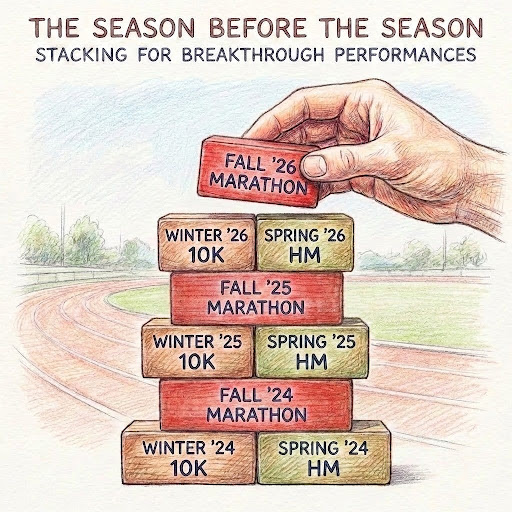
My favorite takeaway from Jason Fitzgerald’s StrengthRunning podcast (to which I’m a regular listener) is ‘The Season Before The Season’. The idea is that breakthrough results don’t come because of one perfect training block; they come when you stack good or great training blocks on top of each other. And if you want to achieve big results in the marathon, in particular, this is super important – runners who run multiple marathons very rarely run their fastest marathon in their debut marathon. There are many reasons why:
Training mileage is a big predictor of marathon performance, and we can only safely increase mileage so much week-to-week.
Let’s say two twin brothers (A and B) are planning their first marathon in fall 2026 (Oct or Nov) and their baseline mileage is about 20mi (32km) per week. To put together a good block for their first marathon this year, they can reasonably get their weekly mileage up to 35-40mi (56-64km). If they try to get their mileage in this block up to 50-60mi, especially without a spring season where they’e already built it up a bit, there’s a high chance they’ll get injured. But they’re conservative and they run the fall ’26 marathon, it goes pretty well, they finish side-by-side and hit their goal of sub 4 hours. Now, things change and they take different paths going into 2027.
Runner A: after the marathon he backs off and stays off. Then after 4 months of winter, he’s like “I can run faster this year, I’m gonna do another one and beat runner B!” He starts training again for a ’27 marathon, he’s got a little more marathon experience but he lost his fitness and his baseline mileage is still just 20mi/wk so he can only safely get up to 35-40mi/wk again. He ends up achieving a similar result in 2027.
Runner B, on the other hand, harnesses the power of The Season Before The Season. He take 7-10 days off after the marathon then gets right back into base training and starts prepping for a winter speed season building up to 5k and 10k races in January/February 2027. He’s kept most of his marathon fitness, keeps doing 1-2 workouts a week, and reduces his long runs back to 10-12mi. After smashing his 5k and 10k PBs, he rolls straight into a spring half marathon season, building his weekly mileage back up to 35-40mi and running a huge half PB in May. Then he starts his base block for marathon training in May/June. His baseline mileage is already at 35mi/wk, and he can reasonably ramp it up to 50-55mi/wk in a 20-week block. Now Runner B is ready to shave 30 min off that marathon PB and run sub 3:30. Moreover, he’s on a super inspiring continuous improvement path leaving him curious and excited about how fast he might ultimately get.
Periodizing allows us to focus on different paces and distances
Runner B doesn’t just outperform Runner A because he puts in more mileage. By focusing on shorter distances–5k, 10k, half marathon–he continues increasing his VO2 max and lactate threshold while Runner A is sitting on the couch. His 5k and 10k-focused interval sessions improved his top-end speed, allowing him to hit faster paces in half marathon training. His lactate threshold improved, allowing him to sustain a faster tempo pace than he could before. If Runner A and Runner B both lined up for the spring half marathon, Runner B would have SMOKED Runner A. And he’ll surely smoke him during marathon training and in the marathon itself so long as he stays healthy.
Continuing to do Strength Training in the “off-season”
If Runner B is smart, he’s continuing to do 1-3 strength sessions per week during his 5k/10k winter season and his half marathon spring season. Strength work isn’t just important for marathon training – it makes a huge difference in performance in shorter races as well. If Runner A still gets into the gym to lift, then this will give him some “off-season” benefit even while he isn’t running, but if he’s off from strength training too, then he’s got a big hill to climb…basically the same hill he already climbed in 2026.
Continuing to prioritize sleep, nutrition, and a healthy lifestyle
If you’re chasing running goals that are important to you–whether they’re marathon goals, shorter races, or ultramarathons–you stack the deck against yourself if you shortchange sleep, eat like crap, or drink heavily. Because of his continued running, Runner B has more positive pressure on maintaining a healthy lifestyle and routines than Runner A. He’ll feel it more than Runner A if his sleep, nutrition, stress, or lifestyle start slipping. If Runner A comes into that 2027 marathon block a few pounds heavier or with sleep deprivation or other lifestyle challenges, it’s going to give him a further disadvantage compared to Runner B.
So play the long game and plan for the long-term
I love the idea that Floris Gierman talks about in his book Running Breakthroughs, challenging runners to not focus so much on the time-on-the-clock in their next race but to set 5-year goals that seem almost impossible now. When we do this, and we build the right habits, establish the right routines, and then stack a season of consistent training on another season of consistent training on another season of consistent training, breakthrough results become almost inevitable. It just requires thinking and planning long-term, not focusing on “what was my pace in the easy run I put on Strava today?” but on “How can I start building towards weekly or monthly mileage PBs?” and “What kinds of races are on my long-term bucket list?” and “What’s a 5-year goal that gives me goosebumps?”
 Run to Lead
Leave a comment