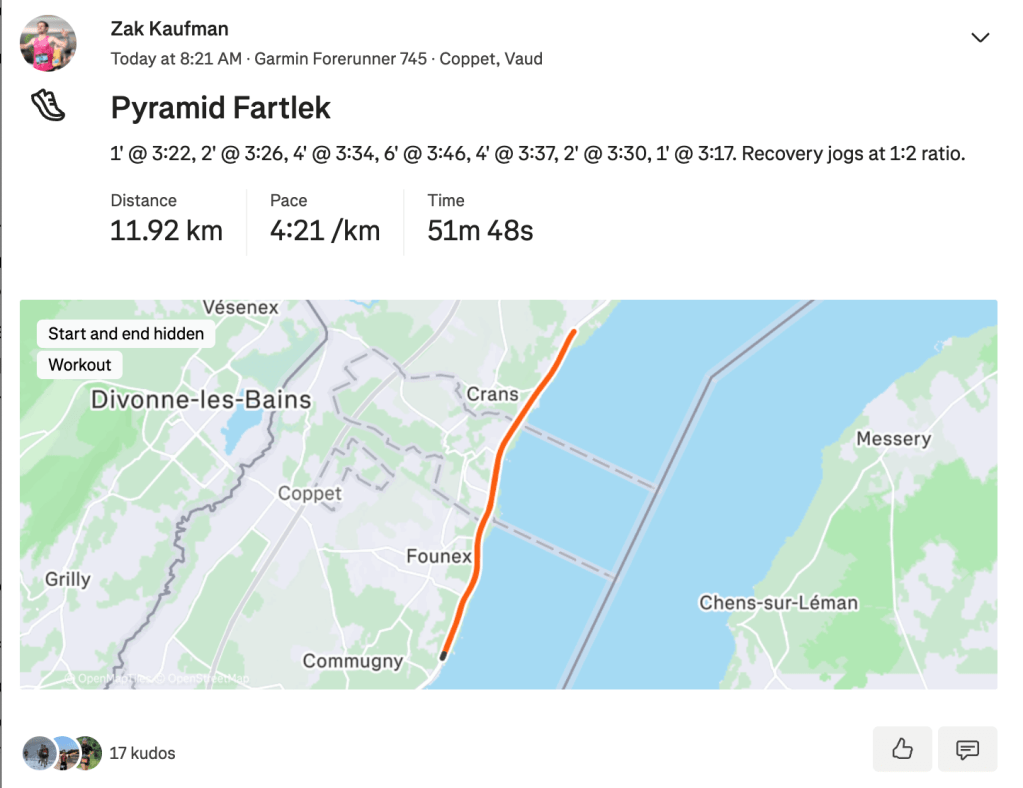
The Aerobic Pyramid Fartlek has become one of my go-to early season workouts. It’s a great way to start building aerobic capacity, gain comfort with different paces, and get a training stimulus that benefits performance in the 10k, half marathon, and marathon. People sometimes call this the ‘1234 pyramid workout’, though I run it a bit differently than that with three longer intervals in the middle (4-6-4 instead of 3-4-3). I’d rate this workout at a 6 out of 10 intensity – great for when you’re still starting to get back into faster sessions. Here’s an example on Strava I ran today. It can be a little tricky to execute, so let’s dive in.
How to run an Aerobic Pyramid Fartlek
Start by warming up as you would for any speed or threshold workout – jog for 10-15 minutes, do some dynamic stretching and drills, then a few strides to get your heart rate up. For the main workout, here’s the structure I use (programming this into your watch is essential):
– 1 min @ 5K pace (30 sec recovery jog) –> 3:20-3:25 for me right now
– 2 min @ 10k pace (1 min recovery jog) –> 3:25-3:30 for me right now
– 4 min @ LT pace (2 min recovery jog) –> 3:35-3:40 for me right now
– 6 min @ HM pace (3 min recovery jog) –> 3:42-3:48 for me right now
– 4 min @ LT pace (2 min recovery jog) –> 3:35-3:40
– 2 min @ 10k pace (1 min recovery jog) –> 3:25-3:30
– 1 min @ 5k pace (followed by 10-15 min cool down jog) –> 3:20-3:25
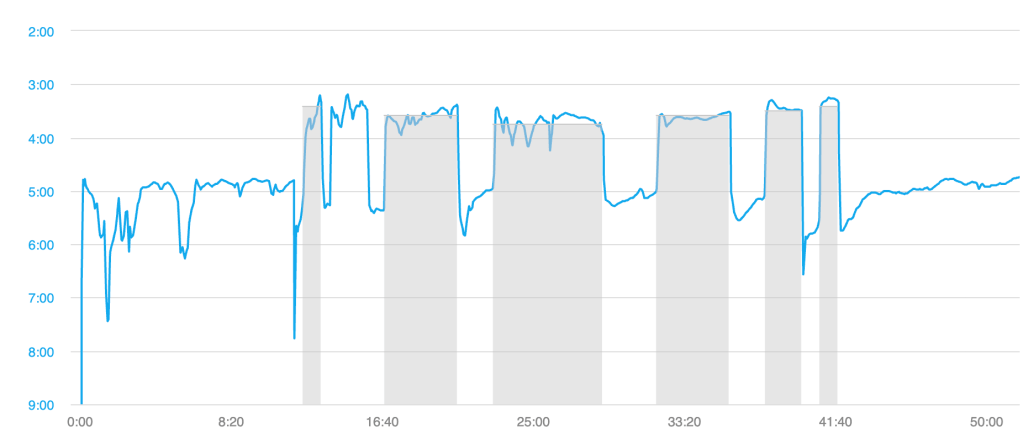
It looks roughly like this on Garmin (note: image is missing the target pace on the first 2 min rep):
Here’s roughly how your heart rate curve will look with an accurate HRM and good execution.
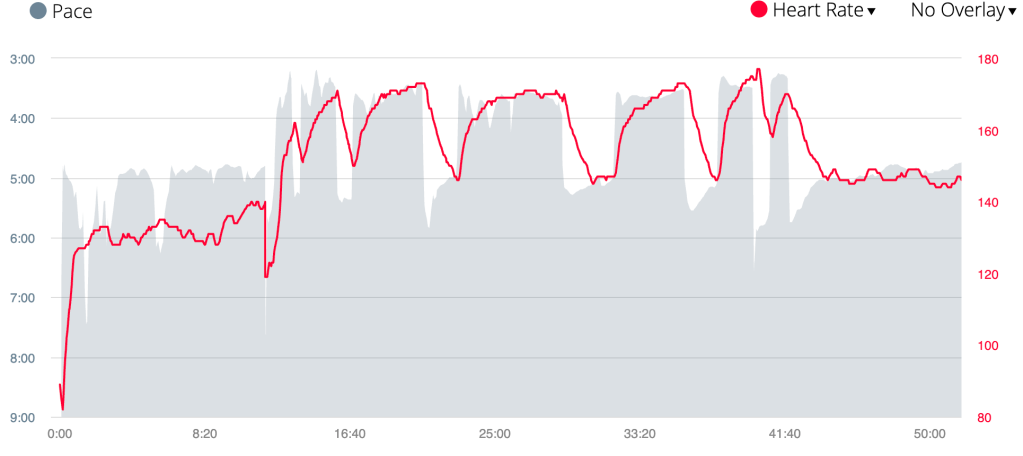
Typically, my HR won’t fully recover to resting during the 30-second or 1-minute recovery jogs, but then it comes back down to the top of Zone 2 during the 2-minute and 3-minute recovery jogs.
Keys to success for running an Aerobic Pyramid Fartlek
Here are some tips for executing this workout effectively.
1. Program the workout into your watch! This is one where it’s too much mental load to try to manage it manually – let your watch tell you what to do when.
2. Use fairly narrow target paces to stay on-track. Keeping the target paces to a 5-8 second window will help you stay alert and on-target. If you’re not sure about these paces, use the McMillan Calculator with input from a recent race (NB adjust the projected paces a few seconds slower if you race with faster shoes).
3. Start conservatively. Don’t blow this workout on the first two reps. You get very little recovery on those. The aim should be to run smooth and quick but not all-out.
4. Run the 6 min interval just slower than your lactate threshold pace. In order to stay sharp for the second half of the pyramid, it’s important that the longest rep (the 6-minute one) is done slightly above your lactate threshold pace. This is the most important rep – if you run it too slow, you won’t get a sufficient threshold stimulus; if you run it faster than your LT pace, you will likely struggle to hit the target paces in the second half of the pyramid.
5. Push the second half of the pyramid a little quicker if you can. The time to challenge yourself in this workout is on the second half of the pyramid. Your legs should be starting to feel heavy by the end of the second 4-minute rep. See if you can beat your rep times from the first half while staying in the target range.
Pyramid Fartlek Variations
Some other ways you can run Pyramid Fartleks:
- Lighter version for beginners doing HM or marathon training: 2′ > 4′ > 6′ > 4′ > 2′ (1:2 recovery ratio)
- Lighter version for beginners doing 5k or 10k training: 1′ > 2′ > 3′ > 4′ > 3′ > 2′ > 1′ (1:2 recovery ratio)
- Harder version for 10k or HM training: 1′ > 2′ > 3′ > 4′ > 5′ > 4′ > 3′ > 2′ > 1′ (1:2 recovery ratio)
- Speed version for mile or 5k training: 200m > 400m > 800m > 1200m > 800m > 400m > 200m (1:2 recovery ratio)
 Run to Lead
Leave a comment