
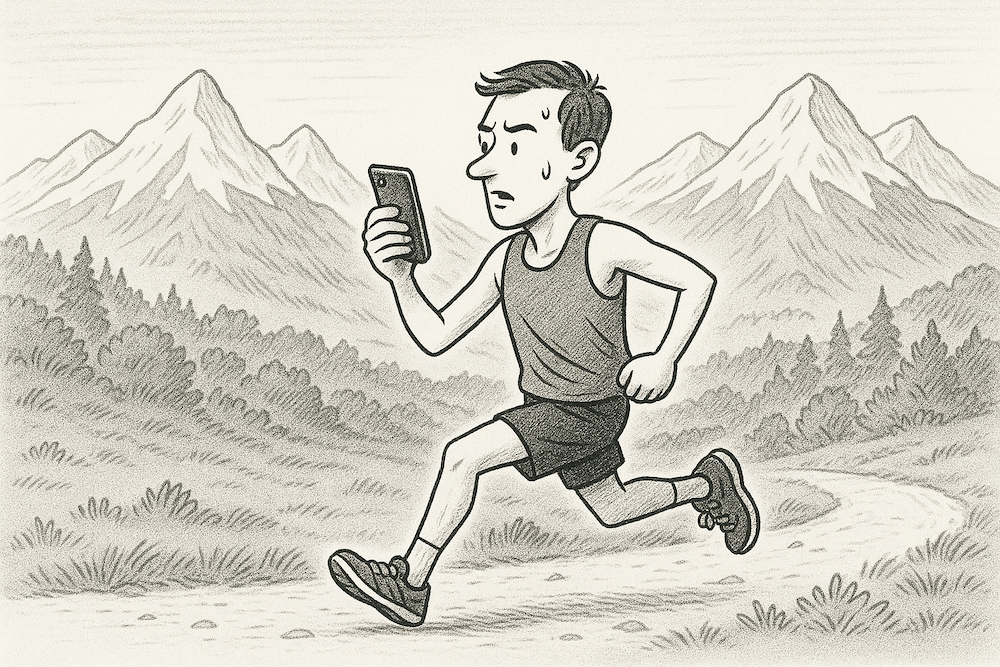
I love Strava. It’s played a key role in helping me rediscover myself and my identity as a distance runner, find new running friends and stay connected with old ones, and motivate me to train more, to get faster, and to stay consistent. It’s also enabled a number of motivating fitness challenges at my company – last year, we collectively ran, biked, swam, and hiked enough miles to cross the whole globe (41,000km). Strava embodies fitness, transparency, and community building – things I deeply value. Without a doubt, Strava has had a solidly net positive impact on the world.
And yet–just as every medicine has its side effects, every big night out has its hangover, and every other social media app has its drawbacks—Strava has its downsides. Specifically, regular Strava users inevitably find themselves grappling with one or more of Strava’s six psychological traps. These ‘traps’ surely don’t exist by design but as an accidental byproduct of Strava’s growth and success. Some of the apps side effects were pointed out in a 2022 study of collegiate club runners published in the Recreation Sports Journal (Russell et al. 2022). Runners using Strava need to be aware of these traps before they find themselves subconsciously tricked into training in ineffective ways that can ultimately undermine their performance.
Runners using Strava need to be aware of these traps before they find themselves subconsciously tricked into training in ineffective ways that can ultimately undermine their performance.
1. The Comparison Trap
Given an open platform where people publish their runs and achievements, it’s natural to want to compare yourself to others. How does this runner’s pace compare to mine? Who has a faster 5k PB? Why am I not as fast as that person? How does my mileage stack up? There’s a hidden reality behind the published paces and PBs, influenced by a wide range of intrinsic and extrinsic factors: temperature, hills, terrain, shoes, wind, elevation, humidity, age, health. Though we may feel drawn to compare ourselves to others, these factors provide a huge asterisk in comparing activities across Strava users (or even comparing one’s own activities against each other).

What you can do: If you really want to compare yourself against somene, run an actual race against them! Or go race a Parkrun and see how you do against others in your age group.
2. The Fitness Score Trap
Like other fitness-tracking apps, Strava Premium gives runners a fluctuating “Fitness Score” – a proprietary algorithm produces a score that naturally decreases over time without activity and increases based on the intensity and duration of each activity. The app congratulates runners when their “Fitness” increases and tells them when it’s holding steady. Experienced runners know that the best way to use fitness scores is to compare them over the long term, eg to look at one’s Fitness Score at the start of this season’s marathon taper vs the start of last season’s taper and the one before. While this sort of long-term comparison can be instructive and may help inform racing tactics, Strava’s Fitness Score graphs focus more on short-term changes, which can motivate runners away from the kind of training that will help them achieve their goals. Behaviors that increase your Fitness Score do not necessarily improve your fitness, race readiness, or performance and vice-versa. During my marathon base training, for example, my Fitness Score inevitably drops several points because I’m not doing weekly intervals or tempo runs. Am I actually losing fitness? No! I’m focusing on building my aerobic endurance and strength so I can tolerate heavier training ahead. Meanwhile, a runner seeking to optimize their Fitness Score—even subconsciously—could end up neglecting base training altogether, taking on too much too quickly (whether in intensity, duration, or both) or short-changing their recovery.
What you can do: Ignore the Fitness Score day-to-day or even consider [gasp] dropping Strava premium and using a tool like Runanalyze or Elevate that provides more nuanced analytics for free.
3. The “Check Out My Pace” Trap
A runner told me recently “I know I should be doing my easy runs slower, but I’m just so competitive and I feel weird having people see me doing runs that slow.” This reflects a common subconscious sentiment many Strava users know well: people will see my pace and judge me. This is in effect the next stage of the Comparison Trap – when it starts to affect how we actually run. This phenomenon was unpacked in a lengthy piece in Outside Magazine by Lizzy Rosenberg.
The impact of this trap can be catastrophic. There’s the aspiring first-time marathoner who runs all her easy base runs way too fast so she’s never getting a good Zone 2 stimulus and increasing her injury risk. There’s the newbie or recently-returned-from-time-off runner whose shyness about comparison keeps them from sharing runs on the platform, from tracking them with a smartwatch and learning from the data, or from running as often as they should. There’s the runner who cuts the warmup or cool down for his workouts short because they slow down his average pace.

What you can do: Remind yourself that fast pace is only a positive thing in workouts and races. Even if others might be unimpressed by your easy run pace – who cares? Taking easy runs easy is what enables you to take hard runs hard.
4. The “Keep-Every-Run-Interesting” Trap
Even if you’re not going to ridiculous lengths to make Strava Art, Strava introduces a subtle pressure to do runs that produce ‘pretty’ or visually interesting maps. Training for marathons or half marathons, however, often involves a lot of boring runs and a lot of repetitive routes. Almost all my long runs are out-and-back on the same bikepath because (a) there are reliable public bathrooms and water fountains in strategic locations, (b) I get more shade than on other routes, and (c) it’s relatively flat and therefore best simulates the course of my next A race (Chicago Marathon) better than if I ran more ‘interesting’ routes.

What you can do: Determine where to run by considering (a) What the run needs to achieve for your training goals (hilly vs flat; road vs trails vs track; etc), (b) where you will have running water or pitstop access if/when needed, (c) where you will be able to run continuously without having to stop for stoplights, run up stairs, cross huge roads, etc.
5. The “Local Legends” Trap
The flip side of the Keep-Every-Run-Interesting Trap is that Strava also gently motivates to runners to run the same segment repetitively, naming he or she who has done the most segment reps in the last 90 days the “Local Legend”. This can psychologically incentivize runners away from variety. Variety in terrain (eg mixing in trails) helps with injury prevention and variety in routes helps keep runners motivated, which is especially important during marathon base training (read: lots of slow, easy runs).
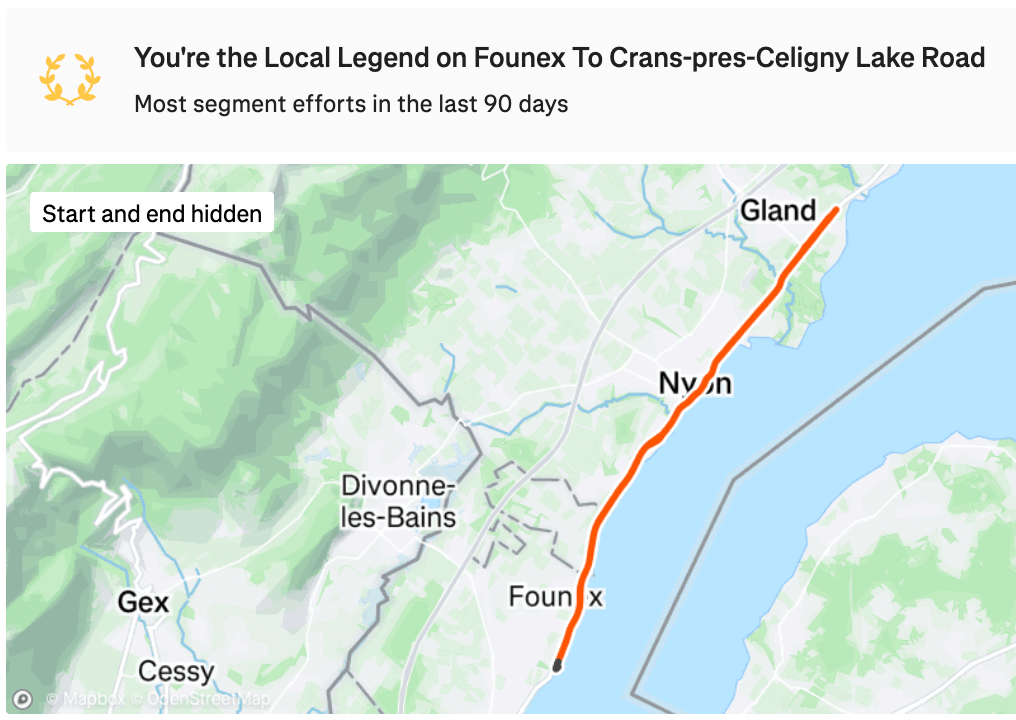
What you can do: Change your settings so that runs are not shared publicly by default, then your runs won’t count towards Local Legends. There are other privacy and security reasons to do this. Other than the Local Legend or Top 10 ranking “recognition” Strava provides on Segments, having activities publicly available is only really beneficial in races and group runs for the sake of connecting to other Strava users.
6. The “Segment Hunting” Trap
This is less common, but runners can be temped into chasing course records or top 10 rankings on random segments. Unless you’ve actually planned a workout route to optimize for fast running on a particular segment—I shamefully admit to having done this one or twice in my early Strava days—then randomly racing an 500m climb or 1.3km section of bikepath is almost certainly a deviation from your training plan.
What you can do: Follow your training plan. Step back and recognize that Strava segments are, by and large, meaningless. Resist the urge to put in extra random effort to conquer a segment or, if you really must get that CR, plan your workout so it’s in the middle of your planned mile repeats or tempo run 🙂
Running Smart: Outcomes over Optics
Millions of runners, like me, find Strava to be a powerful tool for connection, motivation, and accountability. Like any tool, though, its effectiveness depends on how you use it. The psychological ‘traps’ outlined in this piece aren’t flaws in the app itself; they’re reflections of how human psychology is impacted in a social and gamified context. By staying mindful of these pitfalls and keeping our eyes on our real-world goals—whether running for health benefits, chasing PBs, or completing a first marathon—Strava should support our running journeys, not distort them. Remember: the best runs aren’t always the ones that look impressive on Strava — they’re the ones that move you closer to achieving your goals.
 Run to Lead
Leave a comment