
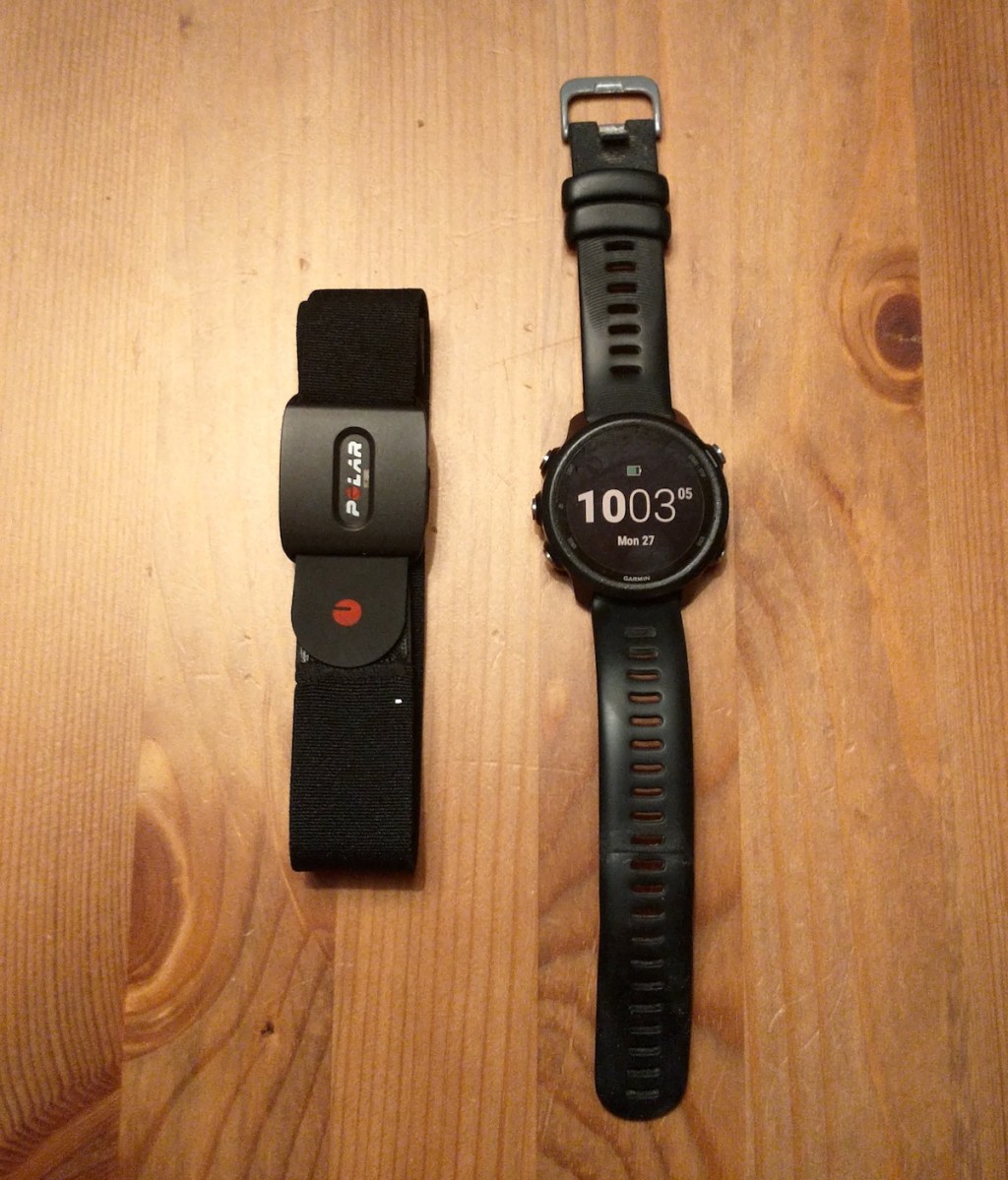
I’ve been training for the last two years using my Garmin Forerunner 245’s wrist-based heart rate monitor (HRM). Wrist-based HRMs are notoriously the least accurate, as they’re quite far from your heart and can be more susceptible to jostling and things you’re gripping (a water bottle, a running stroller, etc). This piece in Trail Runner Magazine sums up some of the research findings on wrist-based HRMs (TLDR: wrist HRMs are more accurate at rest than during activity). My wife gave me a new Polar arm-based HRM over the holidays and I can already confidently say it’s a gamechanger. Here are five differences I’ve noticed since making the switch – I still sometimes forget to put it on, so the last month has provided a few unplanned natural experiments to compare the two HRMs.
#1 Arm HRM provides more responsive readings.
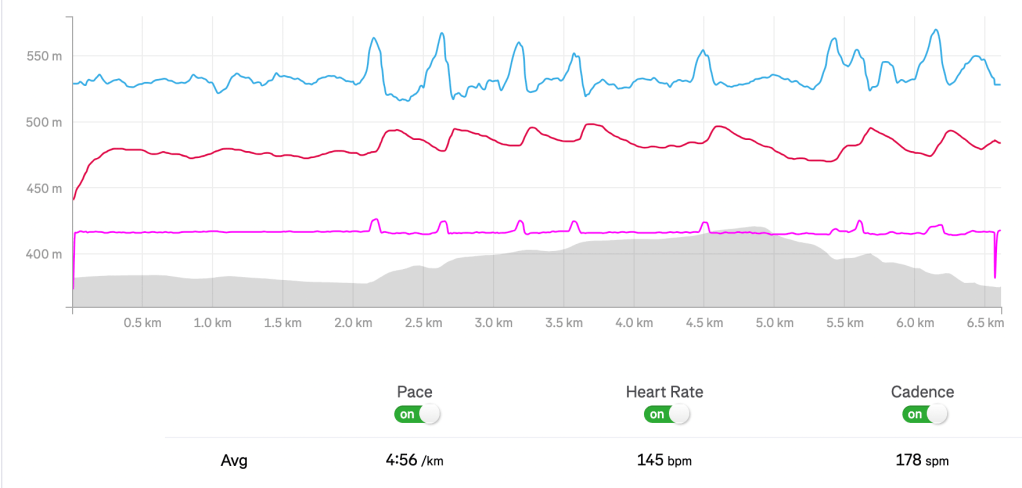
The readings from the arm-based monitor are more immediately responsive to changes in terrain and pace. When I’m using my arm-based Polar HRM, my heart rate will start to climb immediately as soon as I start climbing a hill, it levels off when and it will start dropping as soon as I start descending a hill, whereas my wrist HR tends to lag – my heart rate goes up, but only after 30 seconds of climbing and then it stays elevated after I’ve crested the hill. Similarly, when I do strides or intervals the arm-based monitor shows my HR rising and falling as my pace changes, whereas the wrist HRM usually just shows my HR as elevated the whole time while doing strides (even when recovering). Here are readings from three recent easy runs (two with the arm HRM and one with the wrist HRM).
24 Jan easy run with hill sprints & strides (arm HRM, avg 138)

17 Jan easy run with hill sprints (arm HRM, avg 145)
14 Jan easy run with strides (wrist HRM: avg 154, no variation during strides)

#2 Arm HRM picks up faster at the start.
The wrist HRM will sometimes still show me at a super low HR 400-500m into a run, whereas the arm HRM will start picking up well into Zone 1 within 100-200m.
#3 Arm HRM gives more consistent and predictable readings.
Whereas my wrist HRM will jump up and down, sometimes saying I’m running in mid-zone-3 on an easy run, the arm-based monitor almost always gives a reading that is consistent with what I would guess my HR would be.
#4 Arm HRM creates fewer WTF moments.
The arm-based monitor produces far fewer random fluctuations. The readings don’t jump around like the wrist HR readings. Take a look at the different red curves in the screenshots above – the arm HRM shows a smooth line that jumps when my pace jumps, while the wrist HRM is randomly jagged and jumpy even though I’m running an even pace on a flat bike path.
#5 WAY better readings when skiing or running with a stroller.
My wrist HRM consistently underestimates my HR when running with a running stroller (by at least 10-20%). This is not an issue with the arm HRM. It’s even more pronounced during my favorite form of cross-training, cross-country skiing (the wrist HRM underestimates by 30-50%!).
26 Jan: XC ski using Arm HRM (avg HR 154)

25 Jan: XC ski using Wrist HRM (avg HR 88)

Overall, I’m really glad to have shifted to an arm-based HRM. It’s much more comfortable than a chest strap and I’m much more confident in its accuracy than that of my wrist HRM. The result is that I can get better feedback during workouts and learn more from my day-to-day running data.
 Run to Lead
Leave a comment