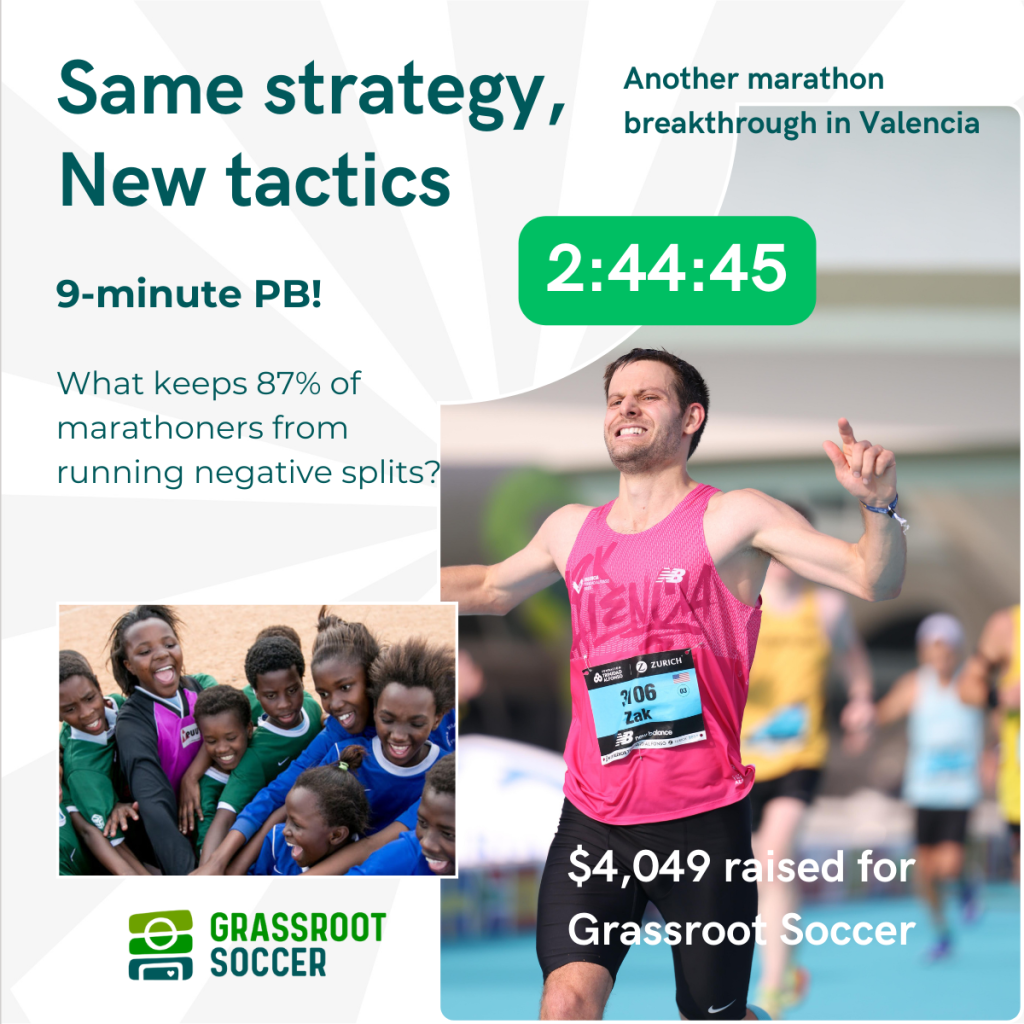
With massive thanks 🙌 to everyone who supported me, I clocked a 2:44:45 (a 9-minute PB) at the Valencia Marathon on Sunday and we raised $4,049 to support Grassroot Soccer’s adolescent health programs! This was my fifth marathon and continued my streak of marathon PBs. Here’s what my progression has looked like.
Rome 2011 (3:28) –> Lausanne 2017 (3:25) –> Lisbon 2022 (3:07) –> Valencia 2023 (2:53) –> Valencia 2024 (2:44)
My Strategy: I kept my training plan 95% the same as last year, just more volume, better nutrition, more strides, and heavier weight training. I posted previously about the six key changes I made in preparation for this race. The bulk of my prep was the same as last year.
My Tactics: I took in 30% more mid-race carbs and set out to run a negative split. I ran the first half in 1:22:57 and the second half in 1:21:48.
–> First 37k: FEEL, FUEL, and FUN.
–> Last 5k: FINISH.
Even or negative splitting a marathon is super hard and super effective.
A study looking at 876k marathon results found that only 13% of marathoners run a negative split but 52% of multi-marathon runners ran their best time when negative splitting!
So what does it take to run negative splits and why don’t more marathoners do it? Part of the answer sits upstream in one’s training strategy (long runs over 34km, heavy strength work, plenty of race-pace workouts, etc), but a lot comes down to race-day tactics:
1. Start out extra slow. Many folks follow the hoards running too quick at the beginning. Taking the first 1-2km slower than race pace, you can use fat as a fuel source at first, conserving glycogen for later. My avg km pace was 3:52; my first km was 4:06. The first 5km of a marathon should FEEL super easy.
2. FUEL like your life depends on it. Even if you avoid “the wall”, your glycogen stores will run critically low in the last 6km. Marathon runners should consume 60-90g of carbs per hour (i.e. 7+ gels) but many only consume 30-50g. I took 7 gels + isotonic, about 65g per hour.
3. Conserve energy in the first half. This lets you pick it up before things get hard and makes the last 10km less grueling. You get a psychological boost from passing instead of being passed, and 90% of runners are slowing down in the last 10-15km. I probably passed 500+ runners in the second half of the race.
4. Plan in advance. I knew the pace and splits I needed in order to hit 2:45. I knew the fuel locations and what fuel to take when. I knew where to look for my wife and daughter in the crowd. I planned all the race morning logistics in advance. This all made race day more FUN – I could be present and enjoy the experience.
All in all, this was an awesome experience – I’m so grateful to everyone who donated and everyone who supported me along the way. I can’t recommend the Valencia Marathon enough for runners of all levels. No qualifying time needed!
 Run to Lead
Leave a comment